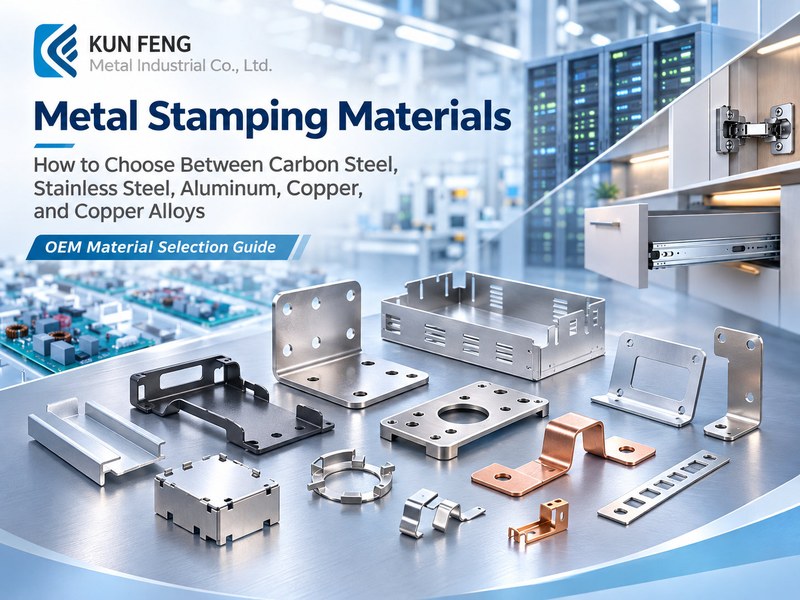
Choosing the right metal stamping material affects part performance, tooling requirements, and production cost. Carbon steel, stainless steel, aluminum, copper, and copper alloys each offer different advantages, but no single material is suitable for every stamped component.
At KUN FENG METAL INDUSTRIAL CO., LTD., we manufacture custom metal stamped parts for OEM customers using these five material categories. This guide compares their properties, explains how to select materials for different applications, and identifies important considerations before mass production.
1. What Materials Are Commonly Used in Metal Stamping?
Five common metal stamping materials are carbon steel, stainless steel, aluminum, copper, and copper alloys. Each provides different combinations of mechanical strength, formability, corrosion resistance, electrical conductivity, and cost.
Carbon Steel
Low-carbon steel grades are commonly selected for stamped structural components because they offer a practical balance of formability, strength, availability, and cost. Typical applications include mounting brackets, reinforcement parts, and structural plates. Higher-strength grades may require additional forming considerations, while unprotected carbon steel generally needs corrosion protection in demanding environments. Other steel grades, including alloy and higher-carbon steels, may also be evaluated depending on strength, wear resistance, and forming requirements.
Stainless Steel
Stainless steel is often selected for components requiring corrosion resistance, durability, and mechanical strength. For example, SUS304 is commonly used where corrosion resistance and formability are important, while appropriately processed SUS301 may be suitable for spring clips and parts requiring repeated elastic deflection. Material grade, strength level, and processing condition must match the intended function.
Aluminum
Aluminum is frequently considered for lightweight stamped components because of its low density and good thermal conductivity. Certain aluminum alloys are suitable for electronic housings, lightweight supports, and thermal-related components. Many alloys also provide useful corrosion resistance, although their formability and durability depend on alloy composition, temper, and service environment.
Copper
Copper is widely used for electrical and thermal applications because of its high conductivity. Common stamped components include electrical terminals, conductive connections, and current-carrying parts. Copper’s relatively soft characteristics make surface protection, burr control, and dimensional accuracy important considerations during stamping.
Copper Alloys
Copper alloys, including brass and phosphor bronze, provide different combinations of strength, formability, conductivity, and spring performance. Brass may be considered for components requiring good formability and moderate electrical conductivity. Suitable phosphor bronze grades can be used for spring contacts requiring repeated elastic deflection. Performance varies according to alloy and temper.
Common Metal Stamping Material Grades at KUN FENG
The following table summarizes the five material categories, grades, main characteristics, and typical applications from KUN FENG’s material chart.
| Material Family | Grades / Designations | Main Characteristics | Typical Applications |
|---|---|---|---|
| Carbon & Alloy Steel | Low-carbon steel / coated steel sheet: SPCE · SPCD · SPCC · SPHC · SECC · SGCC · HC340LA · AISI 1513 · SS400 · S275J0 Medium-carbon / alloy steel: SAE 4130 · SCM440 · S45C · S50C High-carbon steel: SK7 · SK5 |
Good formability; structural strength; wear resistance; heat-treatment properties; cost efficiency. | Automotive parts; hand tools; mechanical components; structural brackets; toothed components. |
| Stainless Steel | SUS301 · SUS301-H · SUS304 · SUS304L · SUS316 · SUS316L · SUS430 · SUS420J2 | Corrosion resistance; elasticity; durability; good mechanical properties. | Precision spring components; deep-drawn parts; medical equipment; electronic components. |
| Aluminum & Aluminum Alloys | A1050 · A3003 · A5052 · A6061 · A7075 | Lightweight; good thermal conductivity; corrosion resistance. | Heat-dissipation components; electronic housings; mechanical brackets. |
| Copper | C1020 · C1100 · C1220 · CW004A · CW020A | High electrical conductivity; high thermal conductivity; good ductility. | Conductive busbars; battery tabs; terminals; electrical connectors. |
| Copper Alloys | C2600 · C2680 · C5191 · C5210 · C7521 · C7701 · C1720 · CuNiSi | Good elasticity; electrical conductivity; mechanical strength; fatigue resistance. | Electronic spring components; connectors; EMI shielding covers; contact terminals. |
2. Carbon Steel vs. Stainless Steel vs. Aluminum vs. Copper vs. Copper Alloys
No single metal is suitable for every stamped component. Comparing the main characteristics of each material helps engineers and OEM buyers identify appropriate options before evaluating specific grades and manufacturing conditions.
| Material | Main Advantages | Key Considerations | Typical Stamped Parts |
|---|---|---|---|
| Carbon Steel | Structural strength, cost efficiency, availability | Corrosion protection; grade-dependent formability | Brackets, mounting plates |
| Stainless Steel | Corrosion resistance, durability | Cost, springback, tooling demands | Clips, covers, structural parts |
| Aluminum | Lightweight, good thermal conductivity | Alloy selection, stiffness, surface damage | Housings, lightweight components |
| Copper | High electrical and thermal conductivity | Cost, burr control, surface protection | Terminals, conductive parts |
| Copper Alloys | Strength, conductivity, spring performance | Alloy-specific properties and temper | Connectors, spring contacts |
Note: This comparison provides general guidance. Properties vary by material grade, temper, thickness, and manufacturing conditions.
Why Do Material Grade and Temper Matter?
Material grade and temper can be just as important as the material family. A formable aluminum alloy may work well for bending, while a higher-strength alloy in a different temper may require adjustments to the bend radius or forming process. Similarly, a copper alloy designed for spring performance may have lower electrical conductivity than commercially pure copper.
Key Takeaways
- Compare specific material grades and tempers, not just material names.
- The final choice should balance performance, formability, and manufacturing requirements.
External Reference: worldstainless – Corrosion Properties
External Reference: Copper Development Association – Copper Conductivity
3. How to Choose the Right Material for Your Metal Stamped Parts
The best material for a stamped part depends on its function, operating environment, and production requirements. OEM buyers should evaluate the finished component’s performance rather than selecting materials based only on price or strength.
Metal Stamping Material Selection Guide
| Product Requirement | Material to Consider | What to Check |
|---|---|---|
| Cost-effective structural support | Low-Carbon Steel | Strength, protective coatings, forming complexity |
| Corrosion resistance | Stainless Steel | Grade, exposure conditions, material cost |
| Lightweight construction | Aluminum | Stiffness, thickness, alloy and temper |
| High electrical conductivity | Copper | Contact design, surface condition, mechanical strength |
| Repeated elastic contact | Suitable Copper Alloys | Fatigue resistance, contact force, conductivity |
These are preliminary material selection options, not final engineering specifications.
What Should OEM Buyers Confirm Before Selecting a Material?
- Part Function: Does the component carry loads, conduct electricity, provide spring force, or protect internal parts?
- Operating Environment: Will it be exposed to moisture, chemicals, vibration, or elevated temperatures?
- Geometry and Tolerances: Can the material meet the required bends, holes, dimensions, and assembly clearances?
- Total Production Cost: Does the material require additional tooling, surface treatment, or secondary processing?
- Production Volume: Is the material suitable for repeatable manufacturing at the expected quantity?
For example, stainless steel may be appropriate for parts exposed to moisture, while coated carbon steel may be more economical if it meets the same corrosion and mechanical requirements. For electrical contacts, pure copper offers high conductivity, but a suitable copper alloy may provide a better balance between conductivity and spring performance.
Key Takeaways
- Select the material according to the finished component’s performance requirements.
- Material cost alone does not determine the most economical manufacturing solution.
4. How Does Material Selection Affect Stamping and Production?
A material may satisfy the product’s functional requirements but still present manufacturing challenges. Strength, thickness, hardness, and formability influence press force, die design, dimensional accuracy, tooling wear, and production efficiency.
Material Thickness and Stamping Capacity
Thicker or higher-strength materials generally require greater force for cutting and forming. However, the required press capacity also depends on the cutting perimeter, part geometry, and specific stamping operation.
At KUN FENG, our typical stamping material thickness range is 0.1–6.0 mm. Under specific material and product conditions, processing thickness may reach approximately 12 mm. Our stamping equipment includes presses with capacities up to 1,000 tons. These figures describe our overall manufacturing capability; actual feasibility must be evaluated for each material and component design.
Springback and Dimensional Accuracy
Springback occurs when a formed metal partially recovers its original shape after the forming force is removed. Its magnitude depends on the material’s mechanical properties, thickness, bending geometry, and forming conditions. Components requiring precise bend angles or tight assembly tolerances may need tooling compensation, forming adjustments, and process verification.
Tooling Wear and Surface Quality
Higher-strength materials may increase forming loads and tooling wear. Aluminum and certain copper materials may be susceptible to galling or surface damage during processing. Suitable die clearance, tooling materials, lubrication, and process control should be evaluated according to the material and part specifications.
What Should Engineers Check Before Production?
- Material grade, temper, and thickness
- Bend radius and forming geometry
- Critical dimensions and tolerances
- Burr direction and edge-quality requirements
- Surface treatment and secondary processing needs
Key Takeaways
- Material selection and tooling design should be evaluated together.
- Early process review helps identify manufacturing risks before full-scale production.
Material behavior affects how stamping dies and manufacturing operations are planned. Our Production page introduces metal forming processes, stamping die development, precision stamping, and secondary production services used to manufacture customized components.
5. Which Metal Stamping Materials Are Used in Different Industries?
Different industries prioritize different material properties. Even within the same industry, stamped components may require different metals depending on their mechanical, electrical, or environmental functions.
Automotive Components
Carbon steel and stainless steel are commonly considered for automotive mounting brackets, reinforcement parts, and mechanical fastening components. Material selection depends on load requirements, corrosion exposure, part geometry, and applicable OEM specifications. For example, SPCC or SPHC steel may be evaluated for mounting brackets, while HC340LA may be considered for certain higher-strength reinforcement parts, subject to the required specifications and forming conditions.
Electronics and Electrical Equipment
Copper and copper alloys are widely used for conductive terminals, electrical contacts, and spring components. Steel, stainless steel, and aluminum may also be selected for structural parts, shielding covers, and electronic housings. For electrical contacts, engineers must consider conductivity, contact resistance, spring performance, and surface treatment compatibility. Material candidates include C1100 copper for conductive terminals, SUS301-H stainless steel for spring clips and mechanical spring-contact components, and C5191 or C5210 phosphor bronze for electrical spring contacts requiring conductivity and spring performance. A5052 aluminum alloy may also be evaluated for lightweight housings.
AI Servers and Cabinet Systems
Server and cabinet systems use stamped metal mounting brackets, structural supports, connecting parts, and enclosure components. Steel and aluminum may be selected for different structural and weight requirements, while copper-based materials are relevant to selected electrical applications. The actual material depends on component function and design specifications. For example, C1100 copper may be considered for AI server busbars, while SPCC or SECC steel may be evaluated for cabinet brackets and enclosures. A5052 aluminum alloy is another option for lightweight components, depending on the design.
Medical Equipment
Stainless steel and other suitable metals may be used for medical equipment brackets, structural supports, housings, and mounting parts. Material selection must account for operating conditions, cleaning requirements, and applicable standards. Materials suitable for general medical equipment structures are not automatically suitable for implants or direct patient contact. SUS304 and SUS316L are possible material candidates for corrosion-resistant equipment components, subject to the intended use and applicable requirements.
Hand Tools and Industrial Hardware
Carbon steel and stainless steel are frequently considered for stamped hardware requiring structural strength, durability, or corrosion resistance. Material grade and finishing requirements should be selected according to mechanical loading and intended service environment. Depending on the part and processing condition, SPCC, S45C, S50C, or SCM440 may be evaluated for specific hardware or mechanical components, with forming feasibility confirmed before production.
KUN FENG supplies custom metal stamped components for cabinet systems, automotive applications, electronics and electrical equipment, hand tools and hardware, AI servers and energy storage systems, and medical equipment. Our Applications page outlines industry-specific component types and OEM manufacturing support.
6. How KUN FENG Supports Material Selection and OEM Production
At KUN FENG, we specialize in custom precision metal stamping for OEM customers, with manufacturing capabilities focused on medium- to high-volume production and long-term supply. We integrate engineering evaluation, tooling development, precision stamping, and secondary processing according to each project’s material, geometry, quality, and production requirements.
Our Integrated Manufacturing Approach
- Engineering Evaluation and DFM Support: We review material properties, part geometry, critical tolerances, and manufacturing conditions to identify potential production challenges.
- Custom Tooling Development: We develop stamping dies, including single-operation and progressive die solutions, based on component and production requirements.
- Precision Metal Stamping: We plan stamping operations and process controls to support dimensional consistency and stable OEM production.
- Secondary Processing and Assembly: We integrate operations such as tapping, drilling, machining, joining, surface treatment, and assembly through our manufacturing operations and qualified supply-chain resources.
Tooling development is part of our integrated manufacturing approach. Its purpose is to support repeatable production and consistent part quality rather than standalone tooling sales.
Our Manufacture page explains how engineering planning, in-house tooling development, precision stamping, and downstream integration work together. For OEM buyers, this connects material decisions with production planning and long-term component supply.
7. FAQ: Metal Stamping Materials
Can the same stamping die be used for different metal materials?
Sometimes, but tooling compatibility must be verified. Different materials may require changes to die clearance, forming conditions, or tooling design because of variations in hardness, strength, and springback. A material change should be evaluated before production.
What material thickness can KUN FENG process?
Our typical stamping material thickness range is 0.1–6.0 mm. Under specific material and product conditions, processing thickness may reach approximately 12 mm. Actual capability depends on material properties, part geometry, tooling design, and press capacity. We review these factors during engineering evaluation.
Can surface treatments be applied after metal stamping?
Yes. Surface treatments can be integrated according to the component’s material and functional requirements. They may improve corrosion resistance, appearance, wear performance, or electrical contact characteristics. Treatment compatibility must be verified, especially for conductive parts where coatings can affect contact resistance and reliability.
Need Help Evaluating Materials for Custom Metal Stamped Parts?
Choosing between carbon steel, stainless steel, aluminum, copper, and copper alloys requires balancing component performance, tooling requirements, and production cost.
Share your part drawings, material specifications, expected production quantities, and application requirements with our team. We can review the project and discuss suitable manufacturing solutions based on its technical and production conditions.
Contact KUN FENG