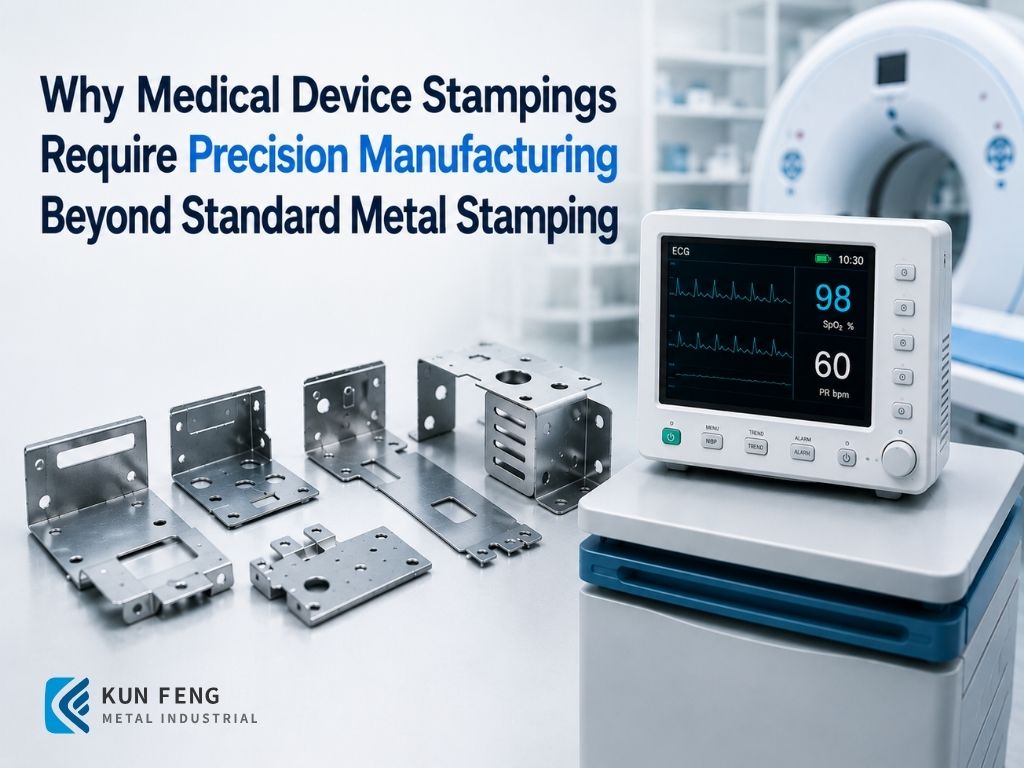
Why Medical Device Stampings Require Precision Manufacturing Beyond Standard Metal Stamping
The medical device industry demands exceptional product quality, reliability, and consistency. Whether manufacturing diagnostic equipment, laboratory analyzers, patient monitoring systems, or healthcare electronics, every component contributes to the overall performance and safety of the final device. Even small metal parts hidden inside the equipment can influence structural stability, assembly accuracy, and long-term operational reliability.
Among these components, medical device stampings are widely used to produce brackets, mounting plates, shielding components, retaining clips, structural supports, and various precision metal parts. While these components may appear similar to standard industrial stampings, the manufacturing requirements behind them are often far more demanding.
At Kun Feng Metal Industrial Co., Ltd., we provide precision metal stamping solutions for OEM customers across a wide range of industries, including medical equipment manufacturing. From tooling development and precision stamping to secondary production services, we understand that producing medical device stampings requires more than simply meeting dimensional specifications. It requires consistent manufacturing processes, stable quality control, and long-term production capability. This article explains why precision manufacturing is essential for medical device stampings and how it helps OEM manufacturers build reliable medical equipment.
1. Medical Device Stampings Require Consistent Precision Throughout the Entire Product Lifecycle
Many people associate precision manufacturing with tight dimensional tolerances. While dimensional accuracy is certainly important, medical device stampings require a much broader level of precision that extends throughout the entire product lifecycle.
Unlike general industrial products, medical equipment often remains in production for many years. OEM manufacturers may continue producing or servicing the same platform long after its initial launch, making consistency between production batches just as important as meeting the original design specifications.
For example, a mounting bracket produced today may need to fit perfectly with assemblies manufactured several years earlier. Even slight dimensional variation can affect component alignment, sensor positioning, or mechanical stability, resulting in additional assembly adjustments or increased quality inspection requirements.
For this reason, manufacturers focus not only on achieving dimensional accuracy, but also on maintaining repeatability throughout every production run.
Precision manufacturing helps ensure:
- Stable dimensions from batch to batch
- Reliable assembly performance
- Consistent interchangeability of replacement parts
- Reduced variation during automated assembly
- Long-term product reliability
Medical device stampings are commonly found in:
- Diagnostic equipment
- Laboratory instruments
- Medical imaging systems
- Patient monitoring equipment
- Healthcare electronics
Across all of these applications, consistency is essential. OEM manufacturers are not simply purchasing metal parts—they are investing in manufacturing processes that deliver dependable quality over the entire product lifecycle.
2. Material Selection Affects More Than Strength
Selecting materials for medical device stampings involves much more than choosing the strongest or least expensive option. Every material influences manufacturability, product durability, corrosion resistance, and long-term production stability.
Different medical devices operate under different environmental conditions. Some components may be installed inside laboratory instruments where corrosion resistance is important, while others function as structural supports that require excellent rigidity and dimensional stability. Electronic medical equipment may also require conductive or shielding components to support electrical performance.
Because of these varying requirements, engineers evaluate multiple material properties before finalizing a design, including:
- Mechanical strength
- Corrosion resistance
- Formability
- Dimensional stability
- Surface finish compatibility
- Manufacturing efficiency
Common materials include:
- Stainless Steel (SUS304, SUS316)
- Aluminum alloys
- Copper alloys
- Electro-galvanized steel for selected structural components
Material selection also affects downstream manufacturing processes. Certain materials may require different forming conditions, tooling designs, or secondary production processes to achieve the desired product quality. Considering these factors early in product development can help reduce manufacturing risks while improving production efficiency.
Rather than viewing material selection as an isolated engineering decision, experienced OEM manufacturers consider it part of the overall manufacturing strategy that balances performance, quality, and long-term production stability.
3. Precision Tooling Is the Foundation of Stable Production
No matter how advanced a stamping press may be, production quality ultimately depends on the precision of the tooling.
Medical device stampings are frequently produced over extended production programs where thousands—or even millions—of parts must maintain consistent quality. During these long production runs, tooling accuracy directly influences dimensional stability, burr control, forming quality, and production efficiency.
Even minor tooling wear can gradually affect:
- Hole position accuracy
- Edge quality
- Flatness
- Bend consistency
- Overall dimensional repeatability
Without proper tooling maintenance and production management, these small variations can accumulate over time and increase inspection costs or assembly challenges.
This is why precision tooling should be viewed as a long-term manufacturing asset rather than simply a production tool. Stable tooling supports consistent product quality while reducing unexpected downtime and improving manufacturing efficiency.
At Kun Feng Metal Industrial Co., Ltd., tooling development is closely integrated with production planning. By considering manufacturability from the earliest stages of a project, we help OEM customers establish stable production processes that support long-term manufacturing programs rather than focusing only on initial sample approval.
Well-designed tooling not only improves dimensional accuracy but also contributes to predictable production performance throughout the entire lifecycle of the product.
4. Surface Quality Influences Both Assembly Efficiency and Product Reliability
When discussing precision manufacturing, surface quality is often associated with product appearance. However, for medical device stampings, surface quality has a much greater impact than aesthetics alone. It directly affects assembly efficiency, mechanical performance, and long-term product reliability.
During the stamping process, improper tooling conditions or insufficient process control may result in burrs, uneven edges, surface scratches, or dimensional inconsistencies. Although these defects may appear minor, they can create significant challenges during assembly, particularly when components must fit precisely with plastic housings, electronic modules, or other precision parts.
OEM manufacturers therefore pay close attention to several surface quality factors, including:
- Burr height and edge condition
- Surface flatness
- Forming consistency
- Dimensional repeatability
- Contact surface quality
Maintaining high surface quality offers several advantages throughout production:
- Smoother assembly processes
- Reduced need for manual rework
- Improved positioning accuracy
- Better fit between assembled components
- Increased long-term product reliability
Many medical device stampings also require secondary production services after the primary stamping process. Depending on the application, these may include deburring, bending, simple assembly, or coordination of surface treatments to ensure the finished component meets the customer's functional requirements.
At Kun Feng Metal Industrial Co., Ltd., secondary production services are integrated with our precision stamping process, helping OEM customers simplify supplier management while maintaining consistent quality throughout the manufacturing workflow.
5. Long-Term Manufacturing Stability Supports Medical Equipment Supply Chains
Medical equipment often remains in production significantly longer than consumer electronics or many industrial products. Diagnostic systems, laboratory analyzers, and healthcare devices may continue to be manufactured, maintained, or serviced for many years after their initial release.
Because of these extended product lifecycles, OEM manufacturers require suppliers capable of delivering not only high-quality components today, but also consistent quality years into the future.
Long-term manufacturing stability depends on several factors:
- Stable tooling management
- Consistent manufacturing processes
- Controlled quality management
- Reliable production scheduling
- Long-term engineering support
Without these capabilities, dimensional variation between production batches may increase over time, creating unnecessary challenges during assembly or replacement part production.
For OEM manufacturers, selecting a precision stamping partner is therefore a long-term strategic decision rather than simply comparing production costs. A supplier with stable manufacturing capability helps reduce production risks, maintain consistent product quality, and support uninterrupted supply throughout the equipment lifecycle.
This level of manufacturing stability becomes increasingly valuable as medical equipment continues to evolve while maintaining long service lives and strict quality expectations.
Why OEM Medical Device Manufacturers Work with Kun Feng
Choosing a supplier for medical device stampings involves much more than evaluating production capacity. Medical equipment manufacturers require a manufacturing partner that understands the importance of precision, consistency, engineering collaboration, and long-term production support.
At Kun Feng Metal Industrial Co., Ltd., we combine precision metal stamping with integrated manufacturing capabilities to support customers from product development through mass production.
Our strengths include:
- Precision Metal Stamping Expertise
We manufacture precision metal components with consistent dimensional accuracy to support demanding OEM applications. - In-House Tooling Development and Maintenance
Tooling development and maintenance are managed internally, allowing better control over production stability and long-term quality consistency. - OEM and ODM Manufacturing Support
We work closely with customers during product development to improve manufacturability and support efficient production planning. - Secondary Production Services
Beyond stamping, we provide secondary production services such as deburring, bending, simple assembly, and surface treatment coordination to streamline the manufacturing process. - Stable Quality Management
Quality is monitored throughout production to help ensure every component consistently meets customer specifications. - Long-Term Production Capability
Our manufacturing approach is designed to support long-term OEM programs with stable quality, responsive communication, and dependable delivery.
Rather than simply producing stamped components, we aim to become a reliable manufacturing partner that supports customers throughout the entire product lifecycle.
Common Applications of Medical Device Stampings
Medical device stampings are used in a wide variety of healthcare equipment where precision, structural stability, and manufacturing consistency are essential.
Diagnostic Equipment
Precision stamped brackets, mounting plates, and structural supports help secure sensors and internal modules while maintaining stable positioning throughout repeated operation.
Laboratory Instruments
Laboratory analyzers and testing equipment utilize stamped components for internal structures, fastening systems, and equipment housings that require consistent dimensional accuracy.
Medical Imaging Systems
Medical imaging equipment often incorporates precision stamped shielding brackets, support frames, and mounting structures that contribute to stable equipment assembly.
Patient Monitoring Devices
Compact patient monitoring equipment relies on lightweight stamped components to support internal electronics, shielding structures, and mechanical assemblies.
Medical Electronics
Grounding brackets, structural reinforcements, mounting plates, and precision fastening components are commonly used in healthcare electronic systems to improve assembly consistency and long-term reliability.
Although many of these components remain hidden inside the equipment, they play a significant role in maintaining the overall performance and durability of modern medical devices.
Frequently Asked Questions (FAQ)
Q1. What are medical device stampings?
Medical device stampings are precision metal components manufactured through metal stamping processes for use in diagnostic equipment, laboratory instruments, patient monitoring systems, medical electronics, and other healthcare equipment.
Q2. What materials are commonly used for medical device stampings?
Common materials include stainless steel, aluminum alloys, copper alloys, and selected galvanized steels. Material selection depends on the application's structural, environmental, and manufacturing requirements.
Q3. Why is precision so important for medical device stampings?
Precision improves more than dimensional accuracy. It also supports reliable assembly, stable production quality, consistent product performance, and long-term manufacturing repeatability throughout the equipment's lifecycle.
Q4. Can stamped components be used in diagnostic equipment?
Yes. Diagnostic equipment commonly incorporates stamped brackets, support plates, shielding components, and structural frames to maintain accurate positioning and stable equipment operation.
Q5. How does tooling influence the quality of medical device stampings?
Precision tooling directly affects dimensional consistency, burr control, forming accuracy, production efficiency, and long-term manufacturing stability. Proper tooling management helps maintain consistent quality across extended production programs.
Q6. Why are secondary production services important?
Secondary production services such as deburring, bending, simple assembly, and surface treatment coordination help improve finished component quality, reduce additional supplier handoffs, and simplify OEM manufacturing processes.
Q7. Besides hospitals, where are medical device stampings commonly used?
Medical device stampings are widely used in laboratory equipment, life science instruments, diagnostic systems, healthcare electronics, medical testing equipment, and various healthcare support devices.
Q8. What should OEM manufacturers consider when selecting a medical stamping supplier?
OEM manufacturers should evaluate a supplier's engineering capability, tooling development, manufacturing consistency, quality management system, secondary production services, and long-term production support—not simply production cost.
Conclusion
Compared with standard industrial metal stampings, medical device stampings demand a much higher level of manufacturing precision, production consistency, and long-term quality management. Success depends not only on producing accurate parts but also on maintaining stable processes, reliable tooling, appropriate material selection, and consistent manufacturing performance throughout the entire product lifecycle.
As medical equipment continues to advance, precision stamped components will remain essential for supporting reliable assembly, structural stability, and dependable product performance. For OEM manufacturers, partnering with an experienced precision stamping supplier can help improve manufacturing efficiency while reducing quality risks over long-term production programs.
Looking for a Reliable Medical Device Stampings Manufacturer?
If your project requires high-quality precision metal components for medical equipment or healthcare applications, Kun Feng Metal Industrial Co., Ltd. provides integrated metal stamping solutions—from tooling development and precision manufacturing to secondary production services and stable mass production. Contact us to discuss your project requirements and discover how our precision stamping expertise can support your next OEM manufacturing program.