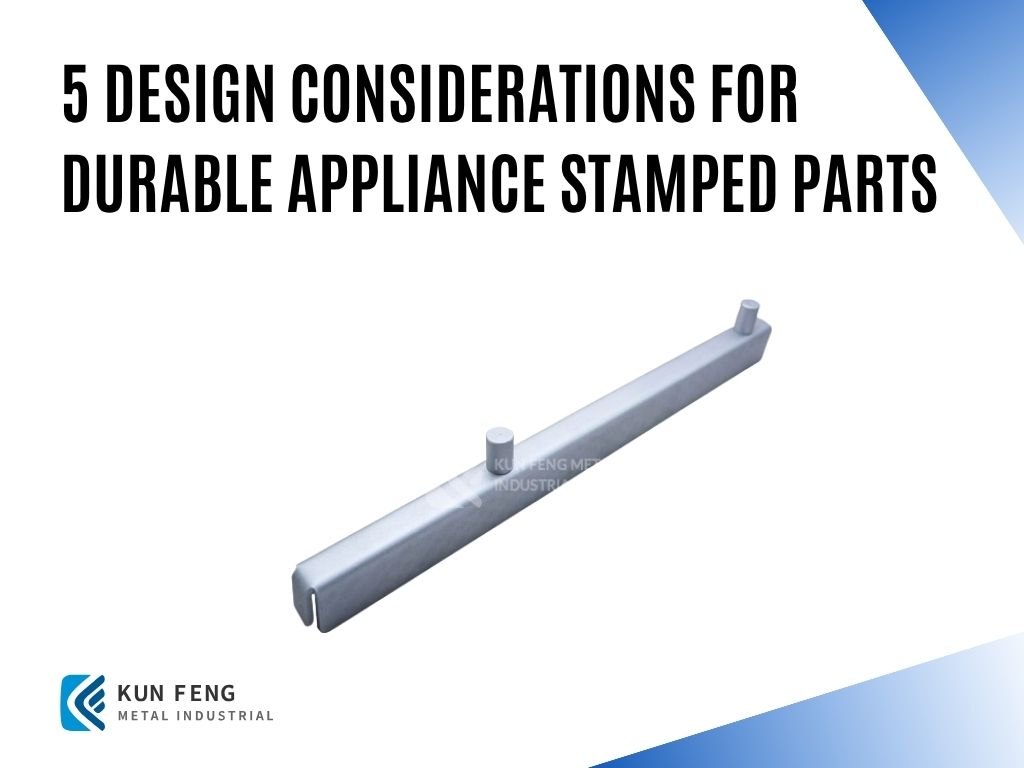
5 Design Considerations for Durable Appliance Stamped Parts
Modern home appliances are expected to deliver long service life, consistent performance, and reliable operation under daily use. Whether in refrigerators, washing machines, air conditioners, ovens, or small kitchen appliances, many critical structural and functional components are manufactured through metal stamping processes.
As home appliances continue to evolve toward higher efficiency, smarter functionality, and quieter operation, manufacturers face increasing demands for product durability and manufacturing consistency. Components that appear simple—such as brackets, clips, mounting plates, and support structures—often play a significant role in overall product performance and lifespan.
At Kun Feng Metal Industrial Co., Ltd., we support OEM customers with precision metal stamping solutions for a wide range of industrial and consumer applications. Understanding the key design considerations behind durable appliance stamped parts can help manufacturers improve product reliability while maintaining cost-effective production.
1. Selecting the Right Material for the Application
Material selection is often the first and most important decision when designing appliance stamped parts. Different appliance environments require different combinations of strength, corrosion resistance, conductivity, and formability.
Common materials used for appliance stamped parts include:
- SPCC Cold-Rolled Steel – Cost-effective and suitable for structural applications.
- SECC Electro-Galvanized Steel – Offers improved corrosion resistance while maintaining good formability.
- Stainless Steel (SUS304, SUS430) – Suitable for humid, high-temperature, or corrosion-prone environments.
- Aluminum Alloys – Lightweight and corrosion resistant for selected appliance applications.
For example, components used near moisture-producing systems such as refrigerators, dishwashers, or air conditioners often require enhanced corrosion protection compared to internal brackets used in dry environments.
Selecting the appropriate material early in the design stage helps improve product reliability and reduce long-term maintenance concerns.
2. Designing for Strength Without Excess Material
A common mistake in appliance component design is assuming that thicker material automatically creates a stronger part. In reality, effective stamped part design often achieves strength through geometry rather than material thickness alone.
Features such as:
- Reinforcement ribs
- Embossed structures
- Formed edges
- Structural bends
can significantly increase rigidity while minimizing material consumption.
This approach offers several benefits:
- Reduced material cost
- Lower component weight
- Improved production efficiency
- Easier assembly
For high-volume appliance manufacturing, optimizing strength-to-weight ratio can generate substantial savings over the product lifecycle.
3. Considering Corrosion Resistance and Environmental Exposure
Home appliances operate in a variety of environments, many of which expose metal components to humidity, temperature fluctuations, cleaning chemicals, or condensation.
Designers should evaluate:
- Indoor humidity levels
- Water exposure
- Heat generation
- Cleaning agents
- Expected product lifespan
Depending on the application, additional protection may be required through:
- Zinc plating
- Nickel plating
- Powder coating
- Electro-coating
- Stainless steel materials
Proper corrosion protection not only improves appearance but also helps maintain structural integrity and product safety throughout the appliance's service life.
4. Optimizing Components for Efficient Assembly
Durability is not determined solely by the stamped part itself. Poor assembly fit can introduce stress, vibration, or misalignment that affects product performance over time.
When designing appliance stamped parts, engineers should consider:
- Mounting hole locations
- Tolerance requirements
- Fastening methods
- Assembly sequence
- Compatibility with automated assembly systems
Well-designed stamped components help reduce assembly errors and ensure consistent positioning throughout production.
This becomes increasingly important as appliance manufacturers continue to adopt automated and semi-automated production lines.
5. Designing for High-Volume Manufacturing Consistency
Even the best component design can fail if it cannot be produced consistently at scale.
Appliance stamped parts are often manufactured in large volumes, making production repeatability a critical consideration. Design features should support stable stamping operations while minimizing the risk of variation during production.
Key considerations include:
- Material flow during forming
- Bend radius design
- Hole-to-edge spacing
- Burr control
- Tooling durability
Components designed with manufacturability in mind are more likely to achieve consistent quality throughout long production runs.
At Kun Feng Metal Industrial Co., Ltd., tooling development and stamping production are planned together to help ensure dimensional consistency and stable supply for OEM manufacturing programs.
6. How Appliance Stamped Parts Affect Noise and Vibration Performance
In modern home appliances, durability is closely linked to noise and vibration performance. Consumers increasingly expect appliances to operate quietly and smoothly throughout their service life. As a result, appliance manufacturers pay close attention not only to electrical performance and appearance but also to the structural stability of internal components.
Poorly designed metal brackets, mounting plates, or support structures can contribute to:
- Excessive vibration
- Rattling noise
- Component misalignment
- Premature wear of adjacent parts
Although appliance stamped parts are often hidden from view, they play a critical role in maintaining overall structural integrity. Properly designed stamped components help distribute loads evenly, secure internal assemblies, and minimize vibration transfer throughout the appliance.
Common examples include:
- Compressor mounting brackets in refrigerators
- Motor support brackets in washing machines
- Fan motor mounting structures in air conditioners
- Internal reinforcement plates in kitchen appliances
By incorporating reinforcement features such as ribs, formed edges, and embossed structures, stamped parts can improve rigidity without significantly increasing material thickness. This helps manufacturers achieve quieter operation while maintaining cost-effective production.
For OEM appliance manufacturers, vibration control is not only a product quality issue but also an important factor influencing customer satisfaction and brand perception.
7. How Appliance Stamped Parts Support Long Product Life Cycles
Unlike many consumer electronics products that may be replaced every few years, household appliances are often expected to operate reliably for 8 to 15 years or even longer.
This long service life places additional demands on appliance stamped parts, which must withstand:
- Repeated vibration cycles
- Temperature fluctuations
- Humidity exposure
- Mechanical loading during operation
- Long-term structural stress
As a result, durability must be considered from the earliest design stage. Material selection, forming design, corrosion protection, and manufacturing consistency all contribute to long-term performance.
For example, a mounting bracket that experiences constant vibration may require higher-strength material or additional reinforcement features. Likewise, components located near moisture sources may require corrosion-resistant materials or protective surface treatments.
Well-designed stamped parts help manufacturers:
- Extend product service life
- Reduce warranty claims
- Minimize maintenance issues
- Improve product reliability
- Strengthen brand reputation
At Kun Feng Metal Industrial Co., Ltd., durability is considered throughout tooling development and production planning to help OEM customers achieve stable, long-term product performance.
Common Appliance Stamped Parts Found in Modern Home Appliances
Stamped metal components can be found throughout many household appliances, including:
Refrigerators
- Internal support brackets
- Compressor mounting plates
- Door reinforcement components
Washing Machines
- Structural supports
- Retaining clips
- Motor mounting brackets
Air Conditioners
- Mounting frames
- Fan motor brackets
- Protective covers
Kitchen Appliances
- Housing components
- Internal support structures
- Retention clips and fastening parts
Although many of these parts remain hidden from end users, they play a vital role in appliance durability and performance.
Why OEM Manufacturers Work with Kun Feng
Selecting a supplier for appliance stamped parts involves more than production capacity alone. Manufacturers need a partner capable of supporting product development, tooling stability, quality consistency, and long-term supply requirements.
At Kun Feng Metal Industrial Co., Ltd., we provide:
- Precision metal stamping solutions
- In-house tooling development and maintenance
- OEM and ODM manufacturing support
- Secondary production services
- Stable quality management systems
- Long-term production and supply capability
By integrating tooling development, precision stamping, and secondary production services, we help OEM customers simplify supplier management while maintaining consistent quality across high-volume production programs.
Frequently Asked Questions (FAQ)
Q1: What materials are most commonly used for appliance stamped parts?
SPCC, SECC, stainless steel, and aluminum are among the most commonly used materials. Selection depends on strength requirements, environmental conditions, and cost considerations.
Q2: Why are stamped parts widely used in home appliances?
Stamping offers excellent dimensional consistency, cost efficiency, and scalability, making it highly suitable for medium- and high-volume appliance production.
Q3: How can appliance stamped parts be made more durable?
Durability can be improved through proper material selection, structural reinforcement, corrosion protection, and manufacturing-focused design.
Q4: Is stainless steel always the best choice for appliance components?
Not necessarily. While stainless steel provides excellent corrosion resistance, galvanized steel or coated materials may offer a better balance between performance and cost depending on the application.
Q5: Can stamped parts support automated assembly lines?
Yes. Properly designed stamped components can improve positioning accuracy, reduce assembly errors, and support efficient automated manufacturing processes.
Q6: Why is tooling design important for appliance stamped parts?
Tooling directly affects dimensional consistency, production efficiency, and long-term quality stability. A well-designed tool helps ensure reliable performance throughout high-volume production programs.
Q7: How do appliance stamped parts contribute to product durability?
Appliance stamped parts provide structural support, secure internal assemblies, and help manage vibration and mechanical loads. When designed with appropriate materials, reinforcement features, and corrosion protection, they contribute significantly to long-term product reliability and service life.
Q8: Are appliance stamped parts important for reducing appliance noise?
Yes. Properly designed brackets, mounting plates, and support structures help reduce vibration transfer and prevent component movement, which can minimize rattling noise and improve overall appliance performance.
Conclusion
Durable appliance stamped parts are the result of thoughtful engineering, proper material selection, and manufacturing-focused design. By considering factors such as structural strength, corrosion resistance, assembly requirements, vibration control, and production consistency, OEM manufacturers can improve product reliability while controlling manufacturing costs.
As home appliances continue to become smarter, quieter, and more efficient, the role of high-quality stamped metal components will become increasingly important in supporting long-term product performance.
Looking for a Reliable Appliance Stamped Parts Manufacturer?
If your project requires precision metal components for household appliances or consumer products, contact Kun Feng. Our team provides integrated stamping solutions that support OEM manufacturing from tooling development to stable mass production.