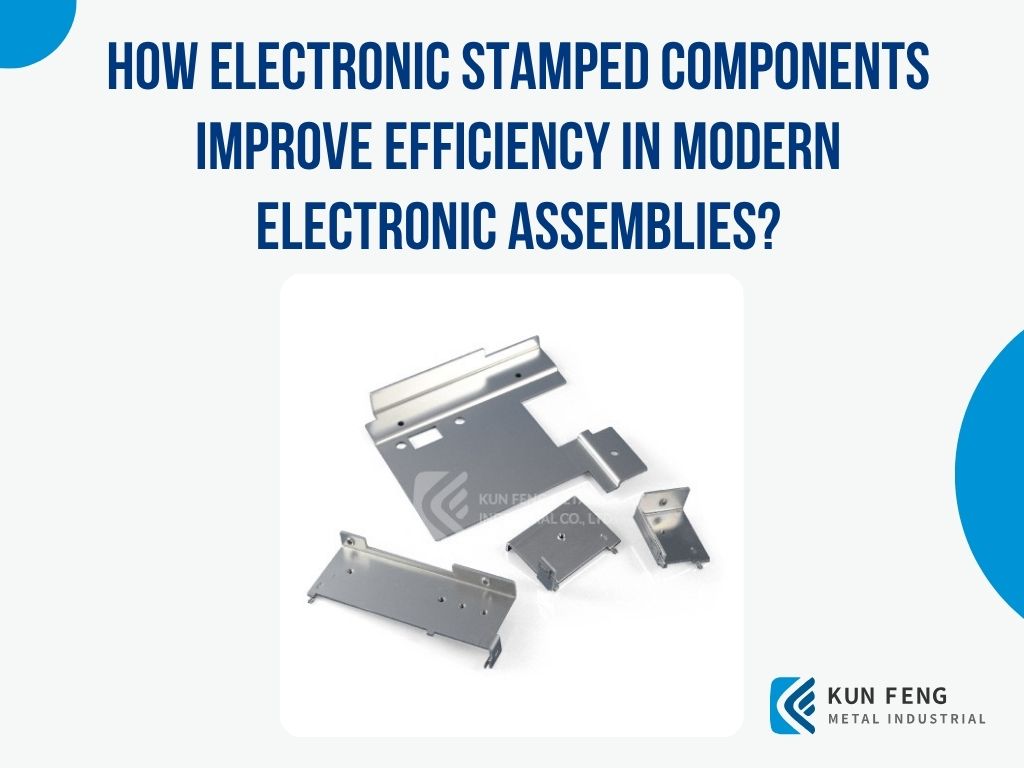
How Electronic Stamped Components Improve Efficiency in Modern Electronic Assemblies?
As electronic products become smaller, more complex, and increasingly integrated, manufacturers face growing pressure to improve assembly efficiency while maintaining strict dimensional accuracy and product reliability. In this environment, electronic stamped components have become an essential solution for OEM manufacturers seeking scalable, cost-effective, and precision-driven production.
From shielding brackets and grounding clips to internal supports and connector plates, stamped metal parts are widely used throughout modern electronic assemblies. Their ability to combine dimensional consistency, material efficiency, and high-speed production makes them ideal for large-scale electronics manufacturing.
At Kun Feng Metal Industrial Co., Ltd., electronic stamped components are produced through precision tooling and integrated stamping processes designed to support long-term OEM supply for electronics and electrical applications. This article explores how electronic stamped components improve efficiency in modern electronic assemblies and why they remain a preferred manufacturing choice.
1. High-Speed Production for Mass Assembly
Electronic products are often manufactured in large volumes with tight delivery schedules. One of the greatest advantages of electronic stamped components is the ability to support rapid, repeatable production through stamping processes.
Once tooling is developed, stamping enables manufacturers to produce large quantities of parts at high speed with minimal manual intervention. This makes stamped components highly suitable for:
- Consumer electronics
- Industrial control systems
- Power supply equipment
- Server and data center hardware
- Communication devices
For OEM manufacturers, this production efficiency helps shorten lead times and support stable assembly schedules.
2. Consistent Dimensional Accuracy for Automated Assembly
Modern electronics manufacturing increasingly relies on automated or semi-automated assembly systems. To maintain stable assembly performance, components must meet strict dimensional requirements.
Electronic stamped components provide excellent repeatability because critical dimensions are controlled directly by the stamping die. This reduces variation across production batches and improves compatibility with automated assembly equipment.
Benefits include:
- Improved fit and alignment
- Reduced assembly errors
- Lower rework rates
- Enhanced final product consistency
For precision-sensitive electronics, dimensional stability is a key reason stamped components are widely adopted.
3. Efficient Material Utilization and Cost Control
Material cost is an important factor in electronics manufacturing, particularly for high-volume OEM programs. Stamping processes optimize material usage through efficient strip layout and progressive tooling design.
Compared with machining-based manufacturing, electronic stamped components often provide:
- Lower raw material waste
- Reduced scrap rates
- Better per-unit cost efficiency
- Improved scalability at volume
This makes stamping particularly attractive for OEM projects with long-term production demand.
4. Support for Complex Functional Designs
Electronic stamped components are not limited to simple flat parts. Modern stamping processes can produce components with bends, forms, tabs, slots, and integrated structural features within a single production flow.
This allows stamped parts to serve multiple functions simultaneously, such as:
- Structural support
- Mounting and fastening
- Grounding and conductivity
- Shielding and enclosure support
- Positioning and alignment
Integrating multiple functions into one component helps reduce part count and simplify assembly design.
5. Seamless Integration with Secondary Processes
Many electronic stamped components require downstream processes such as deburring, surface treatment, bending refinement, or simple assembly.
When stamping is integrated with secondary processing, OEM manufacturers benefit from:
- Reduced supplier coordination
- Shorter production lead times
- Better quality consistency across processes
- Simplified supply chain management
At Kun Feng, electronic stamped components are planned with consideration for downstream manufacturing requirements to support smooth production flow and stable final quality.
Common Applications of Electronic Stamped Components
Electronic stamped components are widely used in:
- EMI shielding brackets
- Grounding clips and conductive parts
- Connector reinforcement plates
- PCB support brackets
- Server chassis internal hardware
- Mounting and fastening brackets
- Heat sink retention clips
As electronics continue to evolve toward higher integration and tighter packaging, demand for precision stamped metal components continues to grow.
Frequently Asked Questions (FAQ)
Q1: What materials are commonly used for electronic stamped components?
Common materials include stainless steel, carbon steel, aluminum, copper alloys, and conductive specialty metals depending on application requirements.
Q2: Are electronic stamped components suitable for precision electronics?
Yes. When properly tooled and controlled, stamped components can achieve the dimensional consistency required for many precision electronic assemblies.
Q3: Can electronic stamped components include formed or bent features?
Yes. Modern stamping processes can integrate multiple bending and forming operations into one production sequence.
Q4: Are stamped components more cost-effective than machined parts?
For medium- to high-volume production, stamped components often provide significantly better cost efficiency than machined alternatives.
Q5: What information is needed to quote electronic stamped components?
OEM buyers typically provide drawings, material specifications, tolerance requirements, surface treatment notes, and expected annual volume.
Conclusion
As electronic assemblies become more compact and production volumes continue to rise, electronic stamped components play an increasingly important role in improving manufacturing efficiency, cost control, and assembly consistency.
Their combination of speed, precision, scalability, and design flexibility makes them a preferred solution for OEM electronics manufacturers worldwide.
Looking for a Reliable Electronic Stamped Components Manufacturer?
If your project requires precision metal parts for electronic assemblies, contact Kun Feng to discuss your drawings and specifications. Our team supports OEM manufacturers with precision stamping solutions designed for long-term production success.